Truth and the Art of Disagreement: A Conversation with Dr. Robert George of Princeton University
Robert George’s Rice Lecture and the Christian Study Center Movement
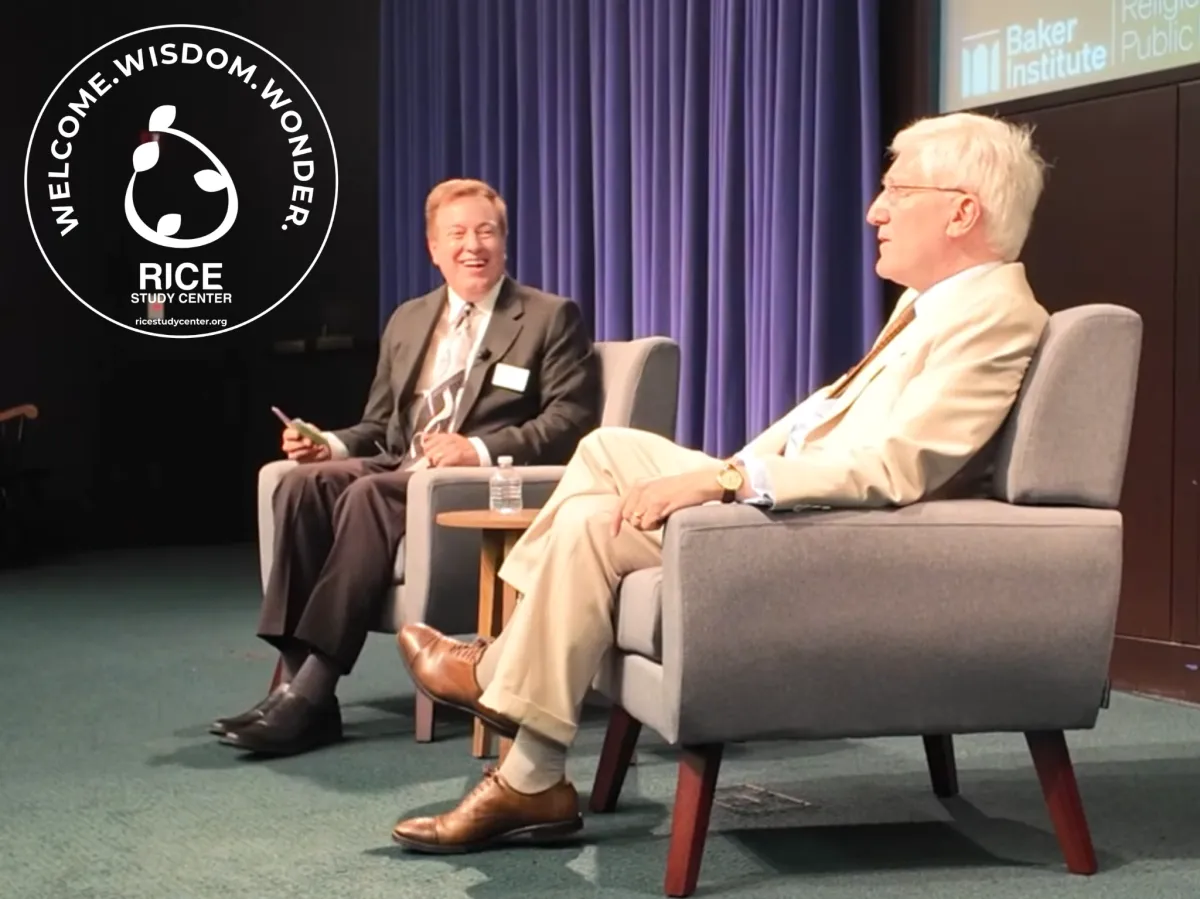
When Dr. Robert P. George, the McCormick Professor of Jurisprudence at Princeton University, sat down with Dr. Michael Emerson at the Baker Institute on September 11, the conversation ranged across natural law, free speech, race, and polarization—but one thread ran through all of it: the conviction that truth is worth pursuing together, even with people who disagree with you.
George’s own account of his “epiphany”—discovering that knowledge has intrinsic, not merely instrumental, value—set the tone. From there, the evening built toward a larger argument: that free societies survive not by enforcing agreement, but by cultivating the humility to be challenged. Citing Mill’s “Trident,” George argued that even a wholly mistaken interlocutor sharpens the thinking of the person who’s right. His decades-long dialogue with Cornel West, a partnership across deep ideological lines, became the night’s clearest illustration—not persuasion, but joint truth-seeking.
That same principle is the founding logic of the Rice Christian Study Center. Where George warned against media silos and the loss of “civic friendship,” RCSC’s three pillars—Welcome, Wisdom, and Wonder—offer a practical antidote: hospitality that gathers students across difference, rigorous inquiry that renews the mind, and vocational discernment that locates faith within a larger story. George’s insistence that universities exist to form whole human beings, not just credentialed workers, echoes almost exactly RCSC’s stated aim of forming “lifelong disciples, not just successful students.”
This is also why the evening mattered beyond Rice’s campus. RCSC is one of 37 centers in the Consortium of Christian Study Centers, a national movement—rooted in institutions like L’Abri and Regent College—built on the same premise George articulated: that serious faith and serious scholarship aren’t rivals. Each center is independently rooted, but shares a conviction that college campuses need a “third space” where students can ask real questions without checking their faith or their intellect at the door.
George’s lecture didn’t just describe that vision. For one night in Baker Hall, it modeled it.
A Word of Thanks
None of this would have been possible without the generosity of the Lanier Theological Library, whose support brought Dr. Robert George to Rice and made an evening of this caliber possible. We’re equally grateful to Dr. Michael Emerson and the Baker Institute for Public Policy for hosting us on campus and for the thoughtful conversation that gave the night its shape. It is exactly this kind of partnership—between donors, institutions, and scholars—that allows the work of the Rice Christian Study Center, and the wider Consortium of Christian Study Centers, to take root and grow.
